
That is why cherry perfumes are rarely just "fruity". Cherry in perfumes has something more theatrical than peach, apple, or pear. It can be juicy and fresh, but also sweet, dense, almond-like, liqueur-like, dark, or slightly feisty. It all depends on how the composition was built and what notes appear alongside it.
Cherry scented perfumes can go towards light, summer freshness. They can also turn into a gourmand vibe, where the fruit meets vanilla, almond, tonka bean, or ambery warmth. In yet another version, cherry becomes more evening-like: set on wood, patchouli, tobacco, or musk, it starts to smell less like a dessert and more like a scene after the last encore.
It is this versatility that makes cherry in perfumes attract so much attention. It does not give a single answer. It can be girly or adult, sweet or dry, light or dark. And the sweet cherry? It brings softness, juiciness, and fruity fullness to this story. Together, they create a red accord that is hard to confuse with anything else.
Cherry and sweet cherry in perfumes – how do these red fruits differ?
Although cherry and sweet cherry often appear side by side, they do not mean exactly the same in scent. Both belong to the world of red fruits, but each carries slightly different associations. Cherry tends to be more distinct, tart, and sometimes darker. It has a tension between sweetness and something astringent, almost liqueur-like. Thanks to this, the scent of cherry in perfumes can seem more complex, even if the note itself is immediately recognizable.
Sweet cherry is usually softer. It is associated with summer, ripe fruit, smooth skin bursting under the teeth, and juice that appears faster than you can reach for a napkin. In fragrance compositions, it gives an impression of fullness, roundness, and juiciness. If cherry has shadow and contrast, sweet cherry more often smells of light, warmth, and fruity abundance.
In perfumery practice, these two fruits often intertwine. The cherry note can have a sweet cherry softness, and the sweet cherry can be enhanced by a tart, darker accent. That is why many people, when looking for cherry scented perfumes, are actually looking for a broader understanding of red fruit: juicy, slightly sweet, but not necessarily candy-like.
This is important because cherry perfumes do not have to smell like a simple fruity syrup. In lighter compositions, cherry can be fresh, bright, and almost sparkling. In more saturated ones — dense, sweet, liqueur-like, or almond-like. If it appears alongside flowers, it gains delicacy. If alongside wood, patchouli, or amber, it becomes deeper and more evening-appropriate.
Sweet cherry, on the other hand, often softens the whole. It gives the composition a juicier sweetness and makes the fruity accord fuller. You could say that cherry gives character, and sweet cherry gives body. One introduces tension, the other softness. Together, they create a scent that does not stop at the first impression but changes depending on what notes are working around it.
That is why with cherry perfumes, it is worth paying attention not only to the name of the fruit itself but also to the rest of the composition. The same red accord can smell different if combined with jasmine, pink pepper, vanilla, almond, musk, or woody notes. Cherry is distinct but very susceptible to context. What appears next to it decides whether the scent will go towards freshness, sweetness, gourmand depth, or a more sophisticated evening.
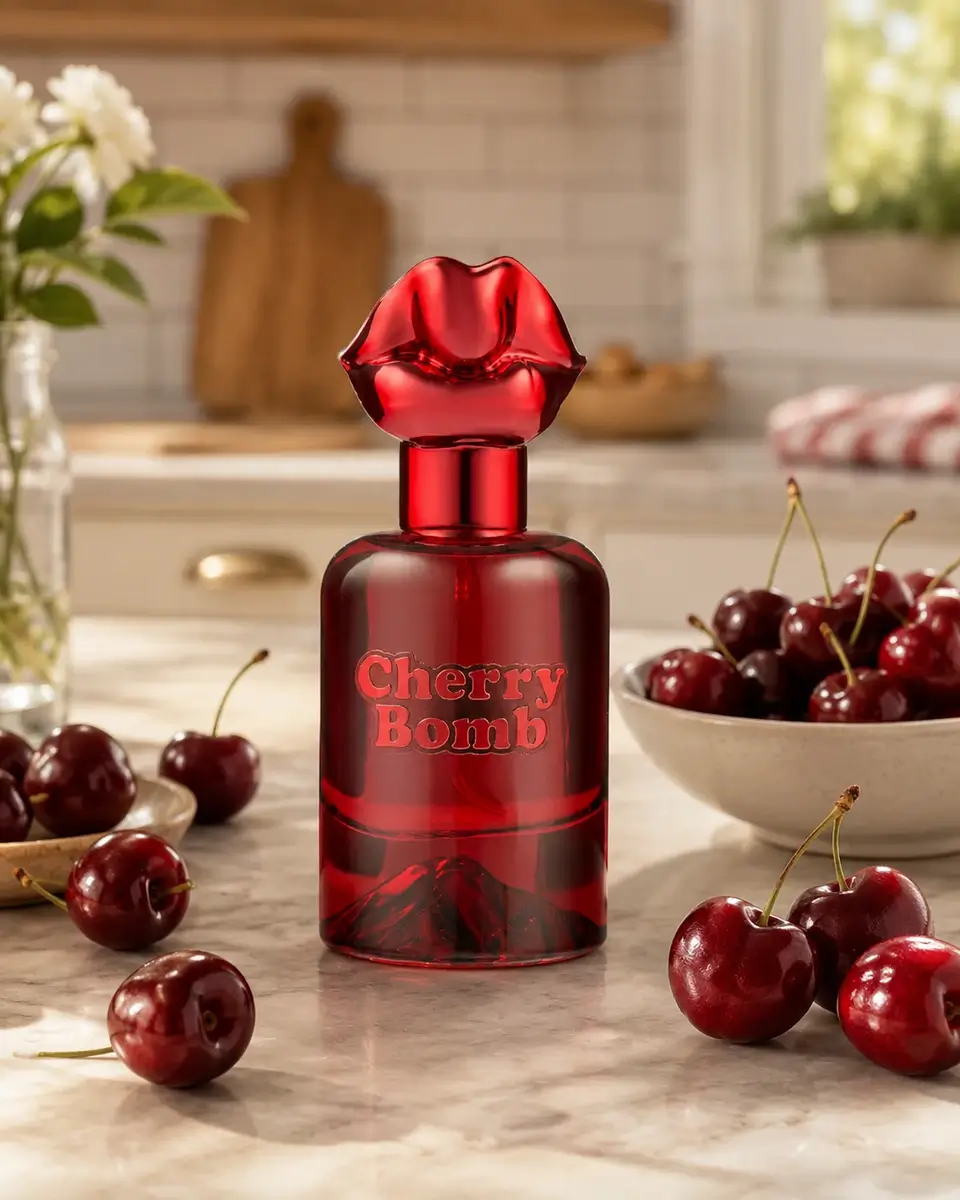
Where does the scenic quality of cherry perfumes come from?
Some fragrance notes are almost invisible. They work in the background, softly complementing the composition, without immediately stepping into the foreground. Cherry is different. It has color, shine, and gesture. Even before we start analyzing its aroma, an image appears: a red stain of juice, lacquered lips, light reflected in a glass, a dessert served after dark, or a stage where something louder than everyday life is about to happen.
This is where its scenic quality comes from. Cherry perfumes often seem more theatrical than other fruity compositions because cherry is not a neutral fruit. It has contrast. On one hand, juiciness and freshness; on the other, sweetness, density, and a slight darkness. It does not have to be heavy to attract attention. It is enough for it to appear in the composition, and the scent immediately gets a more distinct contour.
Cherry also has a strong association with taste. It is a fruit that is easy to imagine not only with the nose but also with the tongue. It can resemble a compote, jam, liqueur, cherry in chocolate, dark syrup, or a fruit picked straight from the tree. Thanks to this, it works very vividly in perfumes. It is not abstract. It immediately triggers the memory of taste, color, and touch.
But the scenic quality of cherry does not only result from sweetness. If it were only about the sweet aroma, many fruits could work similarly. Cherry stands out because it has tension. Its sweetness often goes hand in hand with acidity, and juiciness with something darker. That is why it finds its place so well in evening, sensual, more distinct fragrances. It can fit into the atmosphere of red light, club air, a leather jacket, an old bar, or a concert where the sound stays in the body for a while longer.
In a lighter version, cherry can, of course, smell brighter and more fruity. Then it is closer to summer, freshness, and sweet cherries eaten on the terrace. However, when it is set in a darker composition, it starts to change its tone. It stops being just a juicy fruit.
That is why cherry scented perfumes are so often associated with the evening, even if they are not always heavy. They have something in them that does not pass by completely unnoticed. They do not have to dominate the space to be noticed. Sometimes one red accord is enough, a bit of sweetness, a touch of depth, and that specific aroma that says: this is not just about the fruit. This is about the whole scene in which this fruit appears.
From juicy sweetness to dark gourmand – the different faces of cherry in compositions
Cherry in perfumes has this interesting ability that it rarely stays in one place. It can start lightly, almost sparklingly, like a fruit bursting under the fingers in the middle of summer. In such a version, it is closer to freshness than to heavy sweetness. If lighter compositions, flowers, or a touch of pink pepper appear alongside, juicy cherry gains energy and space. It is not a dessert yet. It is rather a red flash in the air.
It behaves differently when it moves towards gourmand. In combination with vanilla, almond, or tonka bean, it starts to become softer, denser, and creamier. Such a cherry no longer smells just like fruit, but like a memory of something sweet: jam stirred with a spoon, cherries in chocolate, a cake with almond crumble, or a liqueur sipped slowly after dinner. This combination of sweetness and fruity acidity ensures that the aroma does not become flat.
Gourmand cherry could easily go towards excess if not for the contrast. That is why it fits so well with notes that introduce depth: patchouli, wood, musk, ambery accords, or a tobacco background. They do not take away its sweetness but give it weight and a more mature character. The fruit does not disappear, it just stops being obvious. It starts to sit closer to the skin, warmer, sometimes more evening-like.
In such a version, cherry perfumes can be sweet but not infantile. Sensual but not necessarily heavy. Elegant, though still juicy. It all depends on the proportions. On whether the composition wants to stay in a bright orchard, enter a pastry shop after dark, or go down a few steps — to a club where red light reflects off glasses and the scent gets more intense with every minute.
That is why cherry handles mood changes so well. In one fragrance, it can be fresh and fruity; in another, dark, sweet, and almost liqueur-like. It can give the composition energy or, on the contrary — settle it in a warmer, more sensual atmosphere. It is not a neutral note. Even when it appears only as an accent, it usually leaves a trace.
What does cherry combine with in perfumes?
Cherry works well in the company of notes that can bring out its different sides. Some emphasize its juiciness, others warm up its sweetness, and still others push it towards depth and sophistication. That is why the same red fruit can smell completely different depending on what appears next to it.
Cherry and flowers
In combination with flowers, cherry becomes softer and more elegant. Turkish rose can give it a classic, slightly powdery character, and jasmine can introduce a luminous sensuality. In such an arrangement, the fruit does not dominate the entire composition but enters the bouquet — enhancing it with sweetness, color, and a light juiciness.
This is a good solution when the scent is meant to remain feminine but not obvious. Flowers add delicacy to the cherry, and it rewards them with a more distinct contour. Thanks to this, the whole can smell romantic but not too polite.
Cherry and spices
Spices can wake up the cherry. Especially pink pepper breaks its sweetness well and gives the composition a slightly sparkling beginning. Then the fruit becomes more dynamic — less dessert-like, more energetic. Such an accent makes the fragrance seem fresher, faster, and more spacious.
This combination works particularly well when the cherry is meant to maintain its juiciness but is not supposed to be too soft. A spicy flash adds character, much like a detail in an outfit: small, but changing the perception of the whole.
Cherry and gourmand notes
Vanilla, almond, and tonka bean lead cherry towards a warmer, more appetizing direction. Vanilla smooths its acidity, almond adds a slightly bitter, marzipan-like depth, and tonka can close the composition with a velvety, sweetish warmth. In such a version, cherry becomes creamier and more dessert-like, but can still maintain a fruity pulse.
This is one of the most recognizable directions for fragrances with cherry. However, it is not about simple sweetness. The most interesting effects appear when gourmand meets something less obvious: a bit of acidity, a drier accord, a shadow of wood, or a note that does not let the composition settle in sugar alone.
Cherry and a darker base
Patchouli, amber, wood, musk, and woody notes give cherry weight. Thanks to them, the red fruit stops being just juicy and starts becoming deeper, more evening-like, and sophisticated. Wood builds structure, patchouli introduces an earthy shadow, amber adds warmth, and musk can make the whole settle closer to the skin.
In such a base, cherry takes on a different tone. It is no longer just a flash at the beginning of the composition. It stays longer, melts into the warmth of the skin, and creates a more sensual background. This is where the space for fragrances for cooler days, evening outings, and special occasions appears — not because cherry has to be heavy, but because a darker base allows it to show a more mature side.
Cherry Bomb – cherry, sweet cherry, and a rock chorus on the skin
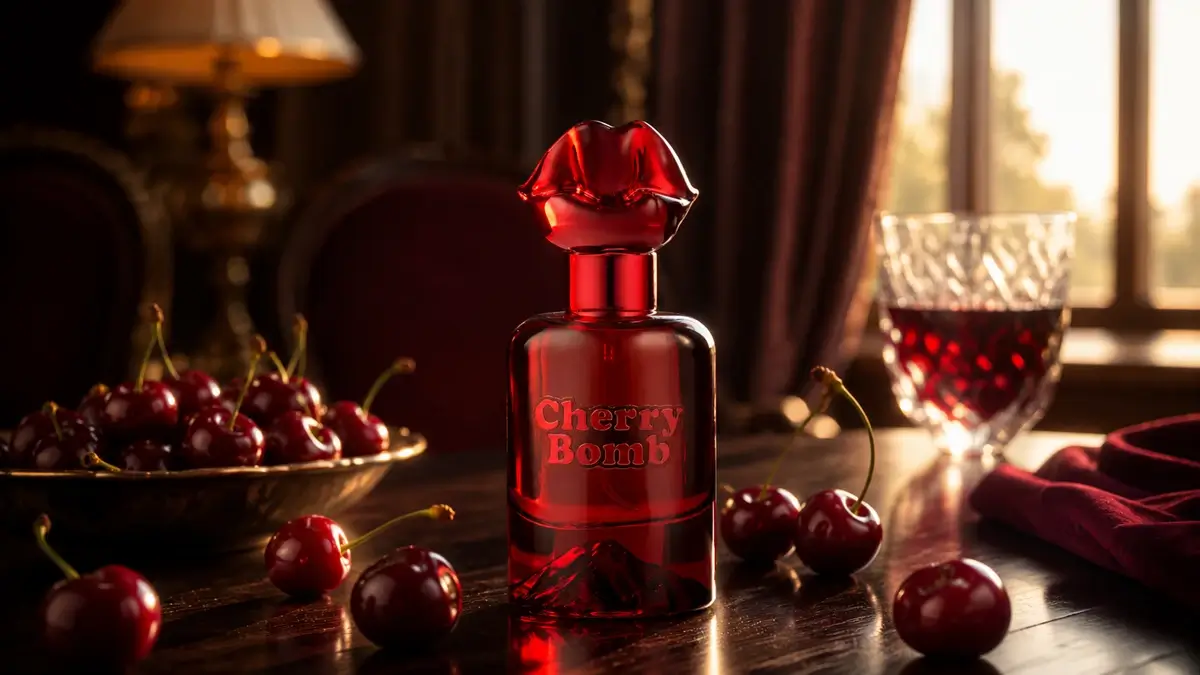
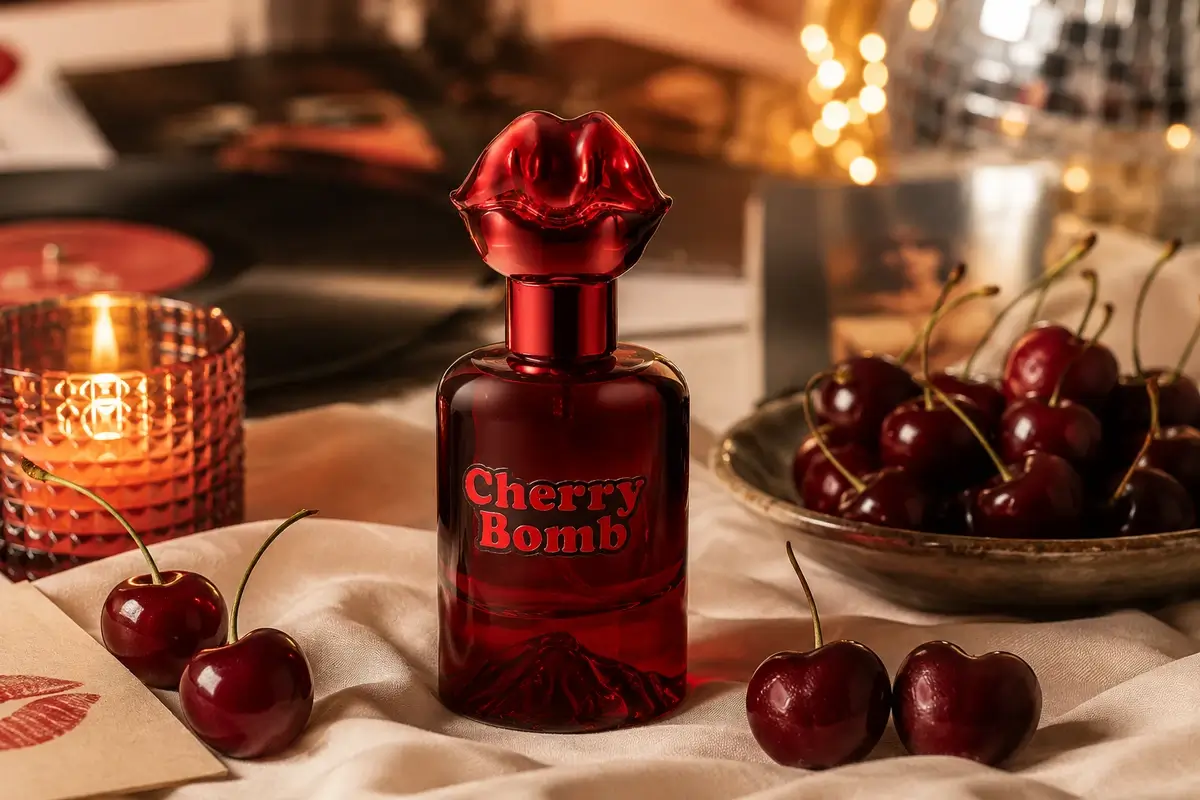
If cherry in perfumes can be juicy, liqueur-like, sweet, or dark, Cherry Bomb shows its more scenic, concert side. This is not a scent from a summer orchard where fruits lie peacefully in a wicker basket. It is closer to red light, a heated hall, the first riff, and that moment when you know the evening won't end after one song.
In the opening, black cherries, Maraschino liqueur, and tobacco leaves appear. This beginning has juiciness, but it is not innocent. Sweet cherry gives fruity fullness, liqueur adds shine and sweet tension, and tobacco introduces a drier shadow. Thanks to this, the composition immediately moves away from a simple association with dessert. It is a combination of cherry and sweet cherry that has character — red, slightly smoky, more evening-like.
In the heart of the fragrance, rhubarb jam, roasted almonds, and Marasca cherry appear. Rhubarb brings an acidic counterpoint, almond adds a warmer, slightly bitter depth, and Marasca cherry returns like a chorus that binds the whole together. This is where Cherry Bomb becomes more gourmand, but does not lose energy. The sweetness here is not smooth and calm. It has movement, tension, and a touch of feistiness.
The base with Peruvian balsam, sandalwood, patchouli, and tonka closes the composition warmer and deeper. Wood gives it structure, patchouli a slightly earthy tone, and tonka introduces a soft, sensual finale. Thanks to this, the scent does not end with the fruity entrance. It remains on the skin as a darker trace — more velvety, warmer, less obvious.
Cherry Bomb can be treated as a proposition for people who like perfumes with cherrybut are not looking for light, bright fruitiness. It is more of a cherry in the red light of the stage than a cherry eaten on a balcony in July. Intense, unisex, with a gourmand center and a darker base, it can be particularly well-suited for evening outings, cooler days, or when the scent is meant to have a clearer character.
It is also worth mentioning the technical side: Cherry Bomb is an extrait de parfum, meaning parfum/extrait de parfum, with a 30% concentration of the fragrance composition.
Who will cherry scented perfumes be a good choice for?
Cherry scented perfumes can be a good choice for people who like fruits but are not necessarily looking for a light, simple, and clearly fresh scent. Cherry gives something more than classic fruitiness. It has sweetness but often also acidity. It has juiciness but can go into a darker, more sensual register. Thanks to this, it is not an obvious note, although immediately recognizable.
It is a proposition for people who like contrasts. If you are attracted to the combination of sweetness and dryness, fruit and wood, dessert and elegance, cherry can turn out to be a very interesting direction. It does not have to smell like candy or compote. In the right composition, it can have something more adult: almond bitterness, ambery warmth, patchouli shadow, or a woody structure.
Cherry perfumes also suit people who like fragrances that attract attention but do not necessarily want to reach for classic floral compositions. Cherry is more vivid. It gives color, taste, and mood. It can be elegant but with a touch of rebellion. It can be sweet but with character. It can be sensual but does not have to immediately go towards a heavy, stifling scent.
It is also worth remembering that cherry works very well in unisex compositions. Depending on the background, it can sound more floral, gourmand, woody, tobacco-like, or ambery. With Turkish rose and jasmine, it gains softness. With wood, patchouli, tonka, or tobacco, it can gain depth and a shade of masculine elegance. It is not a note assigned to only one side of the perfumery shelf. It is more like a prop that changes meaning depending on the scene.
If you are looking for an ideal everyday fragrance, a very sweet, dark cherry might not be the first choice. But if you like scents with a clear character, cherry can be an ideal choice for moments when you want something more memorable. It does not have to be a scent for a grand outing right away. Sometimes an evening walk, a black shirt, a favorite jacket, or a day when you feel like smelling a bit more cinematic than usual is enough.
The most important thing is not to choose cherry perfumes solely by the name of the note itself. One composition can be light and fruity, another sweet and almond-like, and a third dark, woody, and more evening-appropriate. Therefore, it is better to ask not only: "do I like cherry?", but also: "what kind of cherry do I like?". Juicy? Liqueur-like? Floral? Gourmand? Or maybe one that stays on the skin like a red trace after a concert?
Cherry in perfumes – a red accord that stays in memory
Cherry is not a note that disappears without a trace. Even if it appears in a composition only for a moment, it usually leaves a very specific image: a dark fruit, a drop of juice, almond bitterness, a liqueur-like shine, or a sweetness that does not have to be polite at all. That is why cherry perfumes are so often remembered not only with the nose but also with the imagination.
It is one of those notes that are easy to recognize but harder to pin down in one definition. Cherry can smell bright and fresh if it appears in a lighter composition. It can be more sensual when it meets vanilla, tonka, ambery warmth, or musk. It can gain elegance with flowers, especially when Turkish rose or jasmine appear nearby. It can also go towards a darker side if set on patchouli, wood, tobacco, or woody notes.
This is precisely where its strength lies. Cherry scented perfumes do not have to be typically summer, nor exclusively autumn-winter. They do not have to be only sweet, only fruity, or only evening-like. It all depends on the role the cherry plays in the whole: whether it is the first juicy flash, the heart of the composition, or a red accent set in a deeper base.
Therefore, when choosing a fragrance with cherry, it is worth trusting not only the description of the notes but also what happens on the skin. Sometimes the same fruit can surprise you. At first, it seems light and juicy, and after an hour, it becomes warmer, more almond-like, or woody. Other times it starts very intensely, only to settle closer to the body later and remain a more private trace than a loud message.
Cherry and sweet cherry in perfumes have something of a small spectacle. There is color, there is light, there is tension between sweetness and acidity. There is also memory: of summer fruits, desserts, first evenings out of the house, music heard too loudly, and red that always catches the eye. Maybe that is why these notes smell so scenic. Not because they try to play the lead role at all costs, but because once they appear on the skin, it is hard to pretend they are not there.
A story from the brand founder
For me, cherry was never just sweet. It was a fruit that left a trace. On the fingers, on the lips, sometimes on a bright shirt that couldn't be washed completely clean afterwards. Sweet cherries remind me of summer, of a bowl standing on the table, of pits set aside somewhere, and of that moment when you eat fruits a bit mindlessly, one after another, until suddenly it turns out only a handful of stems are left.
Cherry has a different weight for me. It is less innocent. More red than pink. More evening than afternoon. It has something of the first darker lip gloss, of earrings put on "just for a trial", of a concert you were supposed to return from politely before midnight. Of a fruit that starts with sweetness but after a moment shows acidity. And maybe that is why it finds its place so well in perfumes.
I like this tension in it. The fact that it doesn't let itself be easily smoothed out. You can warm it up with vanilla, you can add softness with almond, you can put it next to rose or jasmine, but it still stays itself. Red, juicy, a bit stubborn. Even when it becomes more elegant, it still has something not quite polite in it.
That is why cherry in a fragrance so easily becomes scenic. It doesn't have to fake grand drama. It's enough for it to appear in the right light. A bit of sweetness, a bit of shadow, a bit of skin warmth, and suddenly the fruit stops being just a fruit. It starts to resemble a mood. An evening. A song that comes back to your head the next day. A red accent that changes the perception of the whole style.
What I like most about Cherry Bomb is precisely that this cherry-sweet cherry story doesn't try to be polite. There is sweetness in it, but there is also a darker rhythm. There is fruit, but not the kind from an orchard postcard. Rather from the backstage, from a place that smells of heated skin, smoke, something sweet, and something that cannot be fully named. And I think that's what I like most about red fruits in perfumes: that they can look innocent and smell as if they know more stories than they tell.
FAQ – cherry and sweet cherry in perfumes
How do cherry perfumes smell?
Cherry perfumes can smell juicy, sweet, tart, liqueur-like, or darker and more gourmand. It all depends on what the cherry note has been combined with. In lighter compositions, it can resemble a fresh red fruit, and in deeper ones — cherry in liqueur, jam, a dessert with almond, or a darker, evening accord.
Are cherry scented perfumes very sweet?
Not always. Cherry has natural sweetness, but it is often accompanied by acidity or a slightly liqueur-like character. If it appears with vanilla, almond, or tonka bean, the scent can go towards gourmand. If patchouli, wood, tobacco, musk, or amber are alongside, the whole becomes drier, deeper, and less obviously sweet.
What is the difference between cherry and sweet cherry in perfumes?
Cherry is usually associated with more acidity, distinctiveness, and a darker character. Sweet cherry is softer, juicier, rounder, and more summery. In perfumes, these notes often intertwine, creating a red fruit accord: sweet, juicy, but depending on the composition, also liqueur-like, almond-like, or more sensual.
What does cherry combine best with in perfumes?
Cherry combines well with vanilla, almond, tonka bean, pink pepper, Turkish rose, jasmine, amber, patchouli, musk, and woody notes. Flowers add elegance, spices energy, gourmand notes softness, and a darker base depth and a more evening character.
Will cherry perfumes work in the summer?
Yes, but it is best to choose lighter compositions with cherry, fresh accords, flowers, or pink pepper then. Heavier, sweeter, and more gourmand cherry perfumes usually find themselves better in autumn and winter, when the warm base notes can develop more calmly on the skin.
For what occasions are cherry perfumes suitable?
Lighter cherry perfumes can be suitable for everyday use, especially if they have a fresher, more fruity-floral character. Deeper compositions with vanilla, tonka, patchouli, amber, wood, or tobacco will work best on cooler days, evening outings, and special occasions.
Can cherry perfumes be unisex?
Yes. Cherry does not have to be clearly feminine or masculine. In combination with flowers, it can sound softer and more elegant, and with wood, tobacco, patchouli, tonka, or an ambery base, it can gain depth, dryness, and a shade of masculine elegance. How it is perceived depends on the entire composition and on the skin of the person wearing it.
Is Cherry Bomb a perfume with cherry or sweet cherry?
Cherry Bomb combines black cherries, Maraschino liqueur, and Marasca cherry, so it shows several shades of red fruits at once. It has the juiciness of sweet cherry, a liqueur shine, an almond accent, and a darker base with wood, patchouli, and tonka. It is a more scenic, intense interpretation of cherry and sweet cherry than a light fruity scent for summer.
Do cherry perfumes last long on the skin?
Longevity depends on the concentration of the composition, the notes used, the construction of the fragrance, and the skin itself. Cherry perfumes set on a heavier base, for example with wood, patchouli, amber, tonka, or musk, can usually stay on the skin longer than very light, fresh interpretations. It is best to test them directly on the skin and give them time to develop.
Are cherry perfumes a good choice for a gift?
They can be a good choice if the person you want to gift likes fruity, gourmand, sweet-dry, or more evening-appropriate scents. However, cherry is a distinct note, so it is worth making sure the person likes fragrances with character. If you are not sure, it is safer to choose a smaller format, a sample, or a discovery set.