
If you have read the first part of the post free skincare, then you already know that skincare does not always start at the drugstore. It often begins much earlier - in the bathroom, in the bedroom - in how you treat yourself and your skin. In the first part we looked at the basics: clean hands and teeth, scalp massage, and even sleep.
In this part we are adding more free rituals. Ones that do not require new products, just a little mindfulness and tenderness. Because good skincare does not end on the bathroom shelf. It accompanies you every day - exactly where you are.
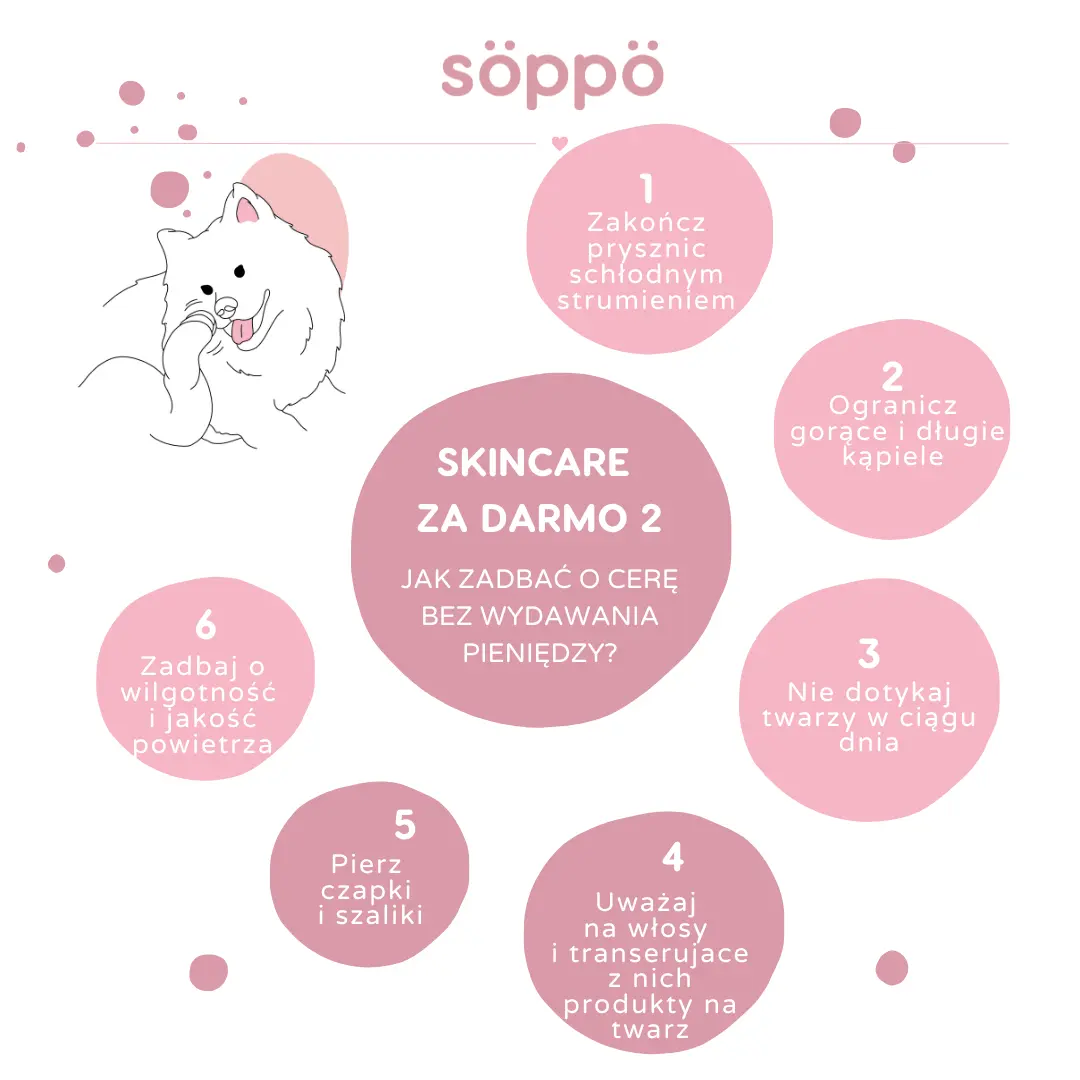
The ending matters - how does water temperature affect the skin?
The water temperature during washing is one of those details we rarely think about in the context of skincare. Which is a pity, because it is exactly what can strengthen or weaken what you do for your skin on a daily basis. The same shower can be a support or an additional burden for the skin - everything depends on the last few moments.
A cool stream at the end of the shower
At the end of your shower, try a simple move: turn the faucet towards cooler water. Not freezing cold. Just cool, the kind that gives a feeling of freshness and a gentle awakening.
Cool water acts on the skin primarily in a soothing manner. It constricts superficial blood vessels, which helps to reduce erythema, redness and morning puffiness. Thanks to this, the skin looks calmer, more rested and uniform. This effect is particularly noticeable in people with sensitive, couperose or inflammation-prone skin.
Contrary to popular myths, cool water does not „close pores” - pores do not have muscles and do not react to temperature in this way. What actually happens is a reduction in tissue swelling and a short-term reaction of blood vessels. The result? The skin appears smoother, tighter, and more organized.
Studies also show that brief contact with cool water can limit local inflammatory reactions and reduce the feeling of burning or itching of the skin. It is not a miracle treatment, but a very simple way to send the skin a signal: „that's enough, you can calm down”.
It does not have to be a grand ritual or a challenge. Just 10-20 seconds at the end of the shower is enough. That is completely sufficient for the skin to benefit from this effect, without stress and without discomfort.
Watch out for hot showers and baths
Hot water can be wonderfully relaxing - it loosens muscles, calms the mind, and helps you unwind. For the skin, however, it is not always an ally.
Showers that are too hot and long baths can compromise the skin's natural protective barrier. High temperature increases the permeability of the skin barrier and facilitates the washing out of lipids, which naturally protect the epidermis against excessive water loss. When this barrier weakens, the skin loses moisture faster, becomes dry, tight, and more prone to irritation and hyperreactivity.
In dermatology, this is referred to as increased transepidermal water loss - but in practice, it simply means that after a hot shower the skin can dry out faster, itch, or react with redness. This especially applies to people with dry, sensitive, atopic, or eczema-prone skin.
Here it is worth distinguishing two things: what relaxes the mind does not always serve the skin. If you love hot baths, you do not have to give them up completely. The golden mean is to shorten the time and lower the temperature to pleasantly warm, not scalding. And if you add a cooler finish to that, the skin will more easily return to balance.
Warm, not hot water is a compromise for the skin between comfort and protection. Such a choice, repeated regularly, makes a bigger difference than it might seem.
What touches your face is often more important than the cosmetic you apply to it
Touch is one of the most underestimated elements of skincare. On the one hand, it can calm, provide a sense of security and closeness. On the other - it can be a silent saboteur working in the background, completely outside of our awareness. Especially when it comes to the face.
Do not touch your face during the day (I know it is difficult)
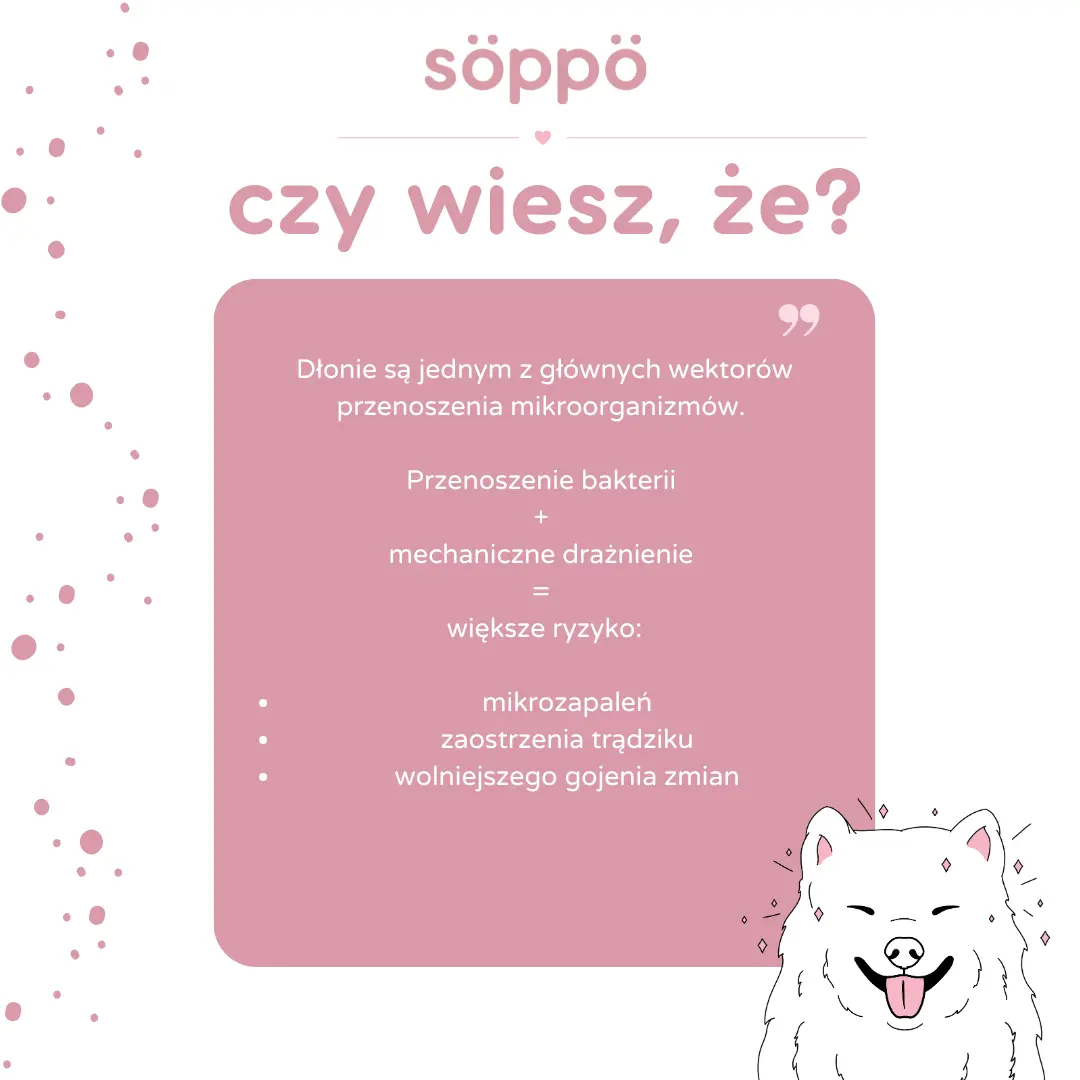
A phone, a keyboard, door handles, a bag, a parcel from a locker. During the day, our hands touch dozens of surfaces. And then - completely instinctively - they wander towards the face.
Touching the skin during the day is more than just an innocent gesture. It is a straight path to transferring bacteria, dirt, and sebum onto the delicate skin of the face. Pressing, scratching, or supporting the cheek with your hand can exacerbate micro-inflammations, irritations, and promote the formation of blemishes.
This habit is particularly important for acne-prone, sensitive, or inflammation-prone skin. Skin that is already in „defense” mode reacts faster and more intensely to any additional stimulus.
However, it is not about controlling yourself at every step or having perfect discipline. It is about mindfulness. About the moment of noticing: „I just touched my face, completely unnecessarily”. The mere awareness of this gesture is often enough to do it less frequently - without tension and without pressure.
Watch out for the hair that touches your face (and what is on it)
Hair is soft, beautiful, and we often treat it as something completely neutral to the skin. And yet, it has very close contact with it - sometimes closer than we would like.
Strands of hair collect dust, air pollution, sebum from the scalp, and residue from styling products. When bangs, loose strands, or ends regularly touch the cheeks, forehead, or jawline, all of this transfers directly onto the skin.
The result? It is easier to get blackheads, minor blemishes, and irritations, especially around the forehead and cheeks. This does not mean that hair is „bad” - it is just worth being aware of its impact.
Sometimes very minor changes are enough: tying your hair up at home, sweeping your bangs aside during work, moving strands away from your face for the night or during skincare. Without judgment, without imposing rules on yourself. A small gesture that can be a great relief for the skin.

Regularly wash hats and scarves - they also touch your face
If you read about pillowcases in the first part, this point is their natural extension. Hats, scarves, and snoods do exactly the same thing, just in a „takeaway” version. They touch the face, neck, and hair for many hours, often when the skin is already warmed up or slightly damp.
You can think of them as mobile pillowcases. They collect sweat, sebum, airborne dust, and everything that settles on them during the day. And then they have direct contact with the cheeks, jawline, chin, and hair.
The effect can be surprising:
- it is easier to get minor blemishes and blackheads around the cheeks and jaw,
- the skin in these areas can be more irritated and reactive,
- hair gets greasy faster, especially near the scalp and around the face.
It is not a matter of poor hygiene, but physics and biology - everything that touches the skin for a long time has an impact on it. That is why regular washing of hats and scarves is one of those simple habits that can genuinely improve skin comfort in winter.
Without rigor and without exaggeration. In the autumn-winter season, once a week is entirely sufficient, or more often if you wear them every day. It is a small gesture that can be a great relief for the skin - especially if you have a tendency for blemishes or irritations in these areas.
Sometimes skincare really starts with things that do not sit on a bathroom shelf.
The air at home also cares for the skin
In winter we mainly focus on creams and oils, and we rarely think about the air in which the skin functions for most of the day. Meanwhile, dry air in the apartment and smog outside can be one of those silent factors that genuinely affect skin comfort - especially when the heating is working at full blast.
When the air is too dry, the skin loses water faster. A feeling of tightness, roughness, and greater reactivity may appear. This does not mean that the skin barrier „breaks down” overnight - rather, it gets an additional burden that it has to deal with.
Add to that the air quality. In winter, we more often breathe air full of dust and pollutants, which act on the skin as an invisible stressor.
Air can act on the skin like an invisible agent: sometimes it calms it, and sometimes it gives it extra work. And this chapter is exactly about these two aspects - air humidity and quality.
Humidity at home - a small trick, a big relief
In winter, the air in apartments can be really dry. And when the air is dry, the skin more often reacts like a „thirsty” skin:
-
it loses comfort and elasticity faster,
-
it is more prone to feelings of tightness, roughness, and burning,
-
it tends to be more reactive, especially if it is already sensitive.
Maintaining proper air humidity helps the skin retain balance and comfort. It is not about perfect conditions or buying more devices. Sometimes very simple, home solutions are enough. If you do not have an air humidifier, you can:
- place a bowl of water in the room, especially near a radiator,
- dry laundry in the room where you spend the most time,
- regularly ventilate the apartment, even in winter, for a few minutes.
These small gestures help increase air humidity and reduce the feeling of skin dryness. This is support, not a treatment - but for many people, it is enough to make the skin calmer, less tight, and simply more comfortable. Sometimes skincare is not another cream, but creating conditions for the skin in which it is easier for it to do what it does best: protect and regenerate itself.
Bonus: smog and pollution - when it is worth thinking about a purifier
Treat this point as a bonus, because equipment actually appears here. But if you live in a place where smog is a frequent guest in winter, it is worth knowing that the skin also has contact with it. Even when you spend most of the day at home.
Studies show that particulate matter and other air pollutants can weaken the epidermal barrier and intensify oxidative stress in the skin. In practice, this can be felt as a greater tendency to dryness, redness, a feeling of „tired” skin, and for some people also as an exacerbation of blemishes or inflammatory reactions.
If you have the opportunity, an air purifier with a HEPA filter can be a real support for skin comfort, because it reduces the amount of dust with which the skin and respiratory tract have contact for many hours. Intervention studies show that air filtration can significantly reduce the concentration of fine particles indoors.
And when it comes to daily skincare, you do not have to build a separate „anti-smog” routine. In practice, the most important things are very basic: gentle cleansing in the evening, to remove impurities from the surface of the skin, and a standard protective layer, which you wear on a daily basis anyway - face cream (for example SPF 50 PA++++ SPFennek sunscreen), BB cream, or foundation and powder. Such a layer of cosmetics creates on the skin a physical barrier, which partially limits direct contact of particles with the skin surface.
It is not an impenetrable shield and does not replace clean air, but as daily support, it is completely sufficient. Therefore, if the question arises in your mind: „do I need a special anti-smog cream?” - in most cases, the answer is: no. First conditions, then simple habits, and only at the end additional products.
The continuation of the same philosophy of skincare without spending money
„Free skincare” is not a list of prohibitions or a plan to tick off. It is rather a way of thinking about skincare - as a daily relationship that changes along with you.
In this second part we were not looking for perfection. We focused on mindfulness. On observing how the skin reacts to small decisions: water temperature, the touch of your hands, the cleanliness of things that have contact with it, the air you breathe every day. Without forcing fixes. Without the pressure that everything has to be done perfectly.
Because skincare does not have to be complicated. Sometimes it is just:
-
a cooler stream of water at the end of the shower,
-
a cleaner hat or scarf,
-
less touching of the face during the day,
-
a little more humidity and better air around you.
Small things. Great effects.
You do not have to implement everything at once. One gesture is enough. One change that will be good for you here and now. And the rest will come with time. Because skincare is not perfection. It is tenderness repeated every day.