
That is exactly why gooseberry scented perfumes can develop in several directions. Some may resemble freshly picked fruit along with the leaves and the green part of the bush. Others will show a gooseberry that is more ripe, juicy and soft. Still others will use it as part of a larger composition, pairing it with flowers, citruses or a deeper base.
So there is no single answer to the question „what does gooseberry smell like in perfumes?”. First you have to ask: which gooseberry?
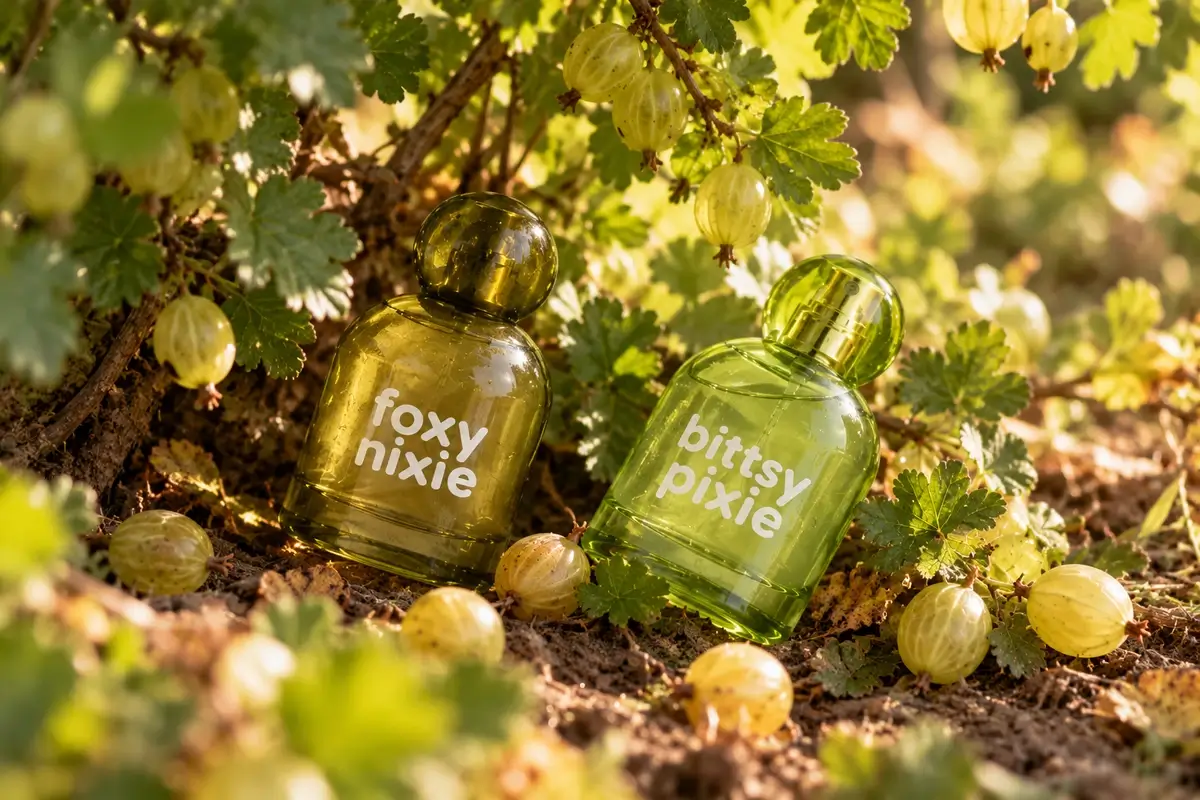
At Söppö, this very difference became the starting point for creating two separate interpretations of the same note. Bittsy Pixie shows a green gooseberry - fresher, more tart and botanical. Foxy Nixie, on the other hand, focuses on a ripe gooseberry - more juicy, soft and sweeter.
This is a good example of how the same fruit can be interpreted by a perfumer in two completely different ways. The note remains the same, but the proportions, accents and the overall fragrance impression change.
What does gooseberry smell like in perfumes?
Gooseberry belongs to the broad family of fruity scents, but it is far from one-dimensional sweetness. It has something in it that allows it to stand with one foot in the fruit world, and the other among green notes.
In its scent profile, you can find juiciness, acidity, freshness and a gently botanical direction. That is exactly why gooseberry can give a composition more tension than a very sweet wild strawberry or a soft, ripe peach fruit.
This is well demonstrated by the very diversity of fruity monoperfumes. Lychee, passion fruit or wild strawberry belong to the same large family, but each of them builds a completely different impression. Fruitiness can be watery, tropical, sour, soft or very sweet.
What is interesting about gooseberry is exactly that its point of balance can be shifted. It can remain green and tart or gain more fruity fullness.
If you like discovering such differences individually, a good starting point are fruity monoperfumes. Focusing the composition around one recognizable motif allows you to notice things that are easily overlooked in a highly complex pyramid.
Green or ripe? Two versions of the gooseberry scent
The difference between these two directions is not solely about one being sour and the other sweet. The entire impression changes: the texture of the scent, its lightness, softness and the associations it can trigger.
Green gooseberry – fruit still a bit „from the bush”
In the scent, you can also imagine what is around the gooseberry: leaves, stems, damp greenery and a slightly botanical aroma, which stays on your hands after picking the fruits. Such an interpretation is fresh, but not in a way typical of mint or aquatic accords. Its freshness comes primarily from the greenery, acidity and the impression of a freshly picked fruit.
This is exactly the version of gooseberry that Söppö shows in Bittsy Pixie – green gooseberry scented perfumes. The composition focuses on a gooseberry that is still unripe: firm, tart, juicy and distinctly green. It does not lead towards jam, cake or a sweet dessert. It is about the moment when the fruit has just been picked from the bush, and its acidity and freshness are most pronounced.
Thanks to this, Bittsy Pixie perfectly shows that a fruity note does not have to mean sweetness. Gooseberry can be raw, provocative and botanical, while still remaining very clearly fruity.
A similar way of looking at a fruity-botanical note can be found in Tangy Tankie – rhubarb scented perfumes. Rhubarb does not smell like gooseberry, but it also shows that a fruity direction does not have to mean sugary sweetness.
Ripe gooseberry – more juice and softness and vinous depth
When the gooseberry stays on the bush longer, its character distinctly changes. The sharp, green acidity mellows, the flesh becomes juicier, and the fruit takes on a fuller sweetness. The sour accent remains present, but it no longer plays the leading role.
This exact moment is what Söppö shows in Foxy Nixie. This is an interpretation of a gooseberry that has really had time to ripen – soft, full of juice and distinctly more fruity than Bittsy Pixie. There is also a gently vinous nuance and a subtle impression of fermentation, like in a fruit left on the bush a bit longer. Because of this, the scent does not simply come down to more sweetness. It has more depth and shows a different stage of ripening of the same fruit.
This is an important distinction, because a ripe gooseberry does not automatically have to smell like jam or dessert. In Foxy Nixie, the sweetness is still broken by the characteristic tartness, and a slightly vinous tone makes the fruit seem more swollen, juicy and almost overripe.
Bittsy Pixie and Foxy Nixie therefore show not so much two different gooseberry scents, but rather two different moments of the same fruit. One was picked earlier, when greenery and tartness dominated. The other was given more time - and it is exactly this time that can be felt in its softer, juicy and vinous character.
Gooseberry note vs. gooseberry accord – what is actually in the perfumes?
When you see the term „gooseberry” in a perfume description, it doesn't necessarily mean that the creator used a single ready-made essence smelling exactly like a fruit picked from a bush.
In perfumery language a fragrance note primarily describes an impression recognized by the nose. It can correspond to a specific material, but it can also be the result of combining several different elements. This is how a fragrance accord.
It is easiest to compare it to music. A single sound is individual. Several selected sounds create an accord, which we begin to perceive as a new whole. It is similar in perfumery: different materials can jointly create the impression of a sour fruit, green skin, leaves and a juicy interior.
Thanks to this, a gooseberry accord can be built in a way that more strongly highlights its specific side. One will be more botanical, the second fruity, the third almost dessert-like.
That is why the list of fragrance notes alone is not always enough to predict how a perfume will smell on the skin. The way the individual elements have been combined with each other also matters.
This is exactly the assumption that also underlines Söppö monoperfumes. „One note” does not have to mean one ingredient. It is about a clear direction – one in which all the elements of the composition work towards a single recognizable impression.
What to pair gooseberry with?
Once we know its two basic faces, it is easier to understand what can be done to it by other notes. Instead of listing random ingredients, you can look at them as three different directions: floral, fresh and enveloping.
Gooseberry and flowers – a garden captured in a scent
Flowers can soften the sharpness of the fruit and give it a more romantic, garden-like background.
An interesting companion for gooseberry can be lilac. Green or more sour fruitiness contrasted with the full scent of flowers creates an association with a garden where several aromas exist simultaneously.
The lilac note itself can be discovered in Doggy Siren – lilac scented perfumes. In such a combination, the lilac does not have to cover the gooseberry – it can serve as its softer background.
A similar function can be fulfilled by violet, shifting the whole thing into a more delicate, floral direction.
Gooseberry and citruses – more light
Citruses lead in a different direction. Instead of softening the fruit, they can highlight its freshness and lightness even more clearly.
Such a combination will work well if we want to preserve the juicy character of the composition, but give it a more luminous opening. The gooseberry can then become part of a fresh, dynamic whole, instead of a dominant note.
If green accords also appear, the composition can stay even closer to the leaves, stems and the fruit picked straight from the bush.
Gooseberry, vanilla, musk and sandalwood – a softer base
The biggest change can be brought by heavier background notes.
Vanilla rounds out the sour edges and can shift the gooseberry towards more dessert-like associations. In the right combination the fruit starts to resemble jam, filling or a gooseberry cake – although the gooseberry itself does not have to have such a character.
Musk works more subtly. It can create a soft, calm base and make the scent perceived closer to the skin.
Sandalwood gives, on the other hand, more depth. The fruity note then stops hanging lightly in the air, and begins to rest on a warmer, woody foundation.
In this way, the same gooseberry note can lead to very different compositions, depending on what accords surround it.
Layering with gooseberry – how to experiment without chaos?
Knowing the combinations is one thing. The other is using them in practice.
Layering consists of applying two or several scents in such a way that they create a new whole. It is easiest to start with monoperfumes, because their character is clearer and it is easier to assess what exactly changed after adding another layer.
First, get to know both scents separately. Check how they develop on your skin and which of their elements are the most interesting to you. Only then start mixing.
Two scents are enough for a start. You do not need a large amount – it is better to start carefully and change proportions in subsequent attempts.
You can also experiment with the application spot. If you apply two scents in the same place, their notes will work together more strongly. If one goes on the wrist, and the other on the neck, the effect will be more spatial.
The most important thing: give the composition at least a dozen or so minutes. The first moment after spraying does not yet show the whole picture.
If you feel like delving deeper into this topic, take a look at the guide Perfume layering – how to combine monoscents to create your own composition?.
Layering is not meant to lead to the „perfect recipe”. It is supposed to help you find out what you like. Sometimes, it is exactly after combining two seemingly simple scents that you start to understand your taste much better.
Which gooseberry is more yours? Compare both versions
The easiest way to check this without guessing is: treat Bittsy Pixie and Foxy Nixie as two separate points of view on the same fruit.
On one wrist apply Bittsy Pixie – green gooseberry, and on the other Foxy Nixie – ripe gooseberry. Thanks to this, you can compare them side by side, instead of trying to remember one scent and only later reaching for the second.
First, pay attention to the initial impression. Bittsy Pixie goes towards a more green, tart and botanical direction. Foxy Nixie shows a gooseberry that is more ripe, juicy and soft, with a gently vinous nuance.
After a dozen or so minutes, check both wrists again. Do not look for an answer to the question of which scent is „better”. Think rather, which one your nose goes back to more often and which one seems more natural to you.
It is worth making one more comparison after a longer time. These are two separate scents, so each develops on the skin at its own pace. Only such a side-by-side comparison clearly shows whether you are more drawn to the fresh, green character of Bittsy Pixie, or the more ripe and juicy version of Foxy Nixie.
You do not have to choose the „right” gooseberry. It is rather about answering a simpler question: which gooseberry is more yours?
Söppö - person first, scent second
At Söppö, we do not treat individual notes like a test of perfumery knowledge. You do not need to know the names of molecules or immediately recognize all the layers of the composition.
Monoperfumes can be a much simpler beginning. They allow you to stop at a single motif and see what actually comes to your mind when you smell it.
For one person, gooseberry can be a sour fruit picked too early. For another, a bowl sitting in the kitchen during summer. Someone will think of a garden, someone of a cake, and someone does not have any history with this scent yet. And that is fine, too.
One of the ideas behind Söppö is thinking about scent as a memory capsule. Not only the ones that already exist. Perfumes can also record new moments: a journey, holidays, a specific person or a completely ordinary day that only turns out to be important over time.
We do not create scents to impose one story on you. We prefer to leave room for yours.
FAQ - gooseberry scented perfumes
Do gooseberry and blackcurrant smell similar?
They are not the same scent, although both fruits can have green, sour and slightly tart accents. Blackcurrant often gives a darker, more distinctive impression, whereas gooseberry can be brighter and more strongly associated with a combination of fresh fruit and greenery. A lot depends on the construction of a specific accord.
Can gooseberry scented perfumes be sweet?
Yes. Gooseberry can be shown in a more ripe, juicier version, and its sweetness can be additionally emphasized with other notes. However, this does not mean that every perfume with gooseberry will be sweet – they could just as well go in a green and dry direction.
Can gooseberry perfumes be gourmand?
Yes, if the gooseberry is properly combined with vanilla, creamy notes, or other accords associated with a dessert. Then an association with jam, filling or a gooseberry cake may appear. However, the gooseberry itself does not have to be a gourmand note.
Can gooseberry perfumes be worn all year round?
Yes. The season can influence the way we perceive a scent, but it is not a rigid rule. In the summer you can particularly appreciate the fresher and greener interpretations, whereas in colder months compositions with a warmer base can sound interesting. Personal preferences are the most important.
Are fruity perfumes only for women?
No. Fragrance notes do not have a gender. Gooseberry, citruses, passion fruit or other fruits can appear in perfumes described as women's, men's or unisex. Whether you want to wear a specific scent is much more important than the category assigned to it.
Is gooseberry a common note in perfumes?
Gooseberry does not belong to the most obvious and most frequently encountered fruity notes. Citruses, peach, pear or red fruits appear in perfumes more often. That is exactly why gooseberry can be an interesting choice - it combines the juiciness of a fruit with acidity and a green, slightly botanical character.
It can appear as an element of a larger composition or become the main motif of a scent. At Söppö, we show both of its faces separately: Bittsy Pixie focuses on the green gooseberry, and Foxy Nixie on its more ripe, juicy interpretation.