
In a world full of promises - lifting creams, anti-aging treatments and serums that are supposed to "turn back time" - it is easy to forget that our skin, body and mind have their own ways of regenerating. Ones that do not require spending money, but only a little tenderness, movement and rest.
In this post, we will not sell you the secret of youth in a jar. Instead, we will talk about three things you already have in your life - or that you can bring back: walking, sleep and friendship.
Because sometimes the most rejuvenating things are the ones that simply give us relief. A breathing body after a long walk. Deep sleep, after which you wake up without tension. A message from a friend, after which you feel that you are seen. This is a post about the fact that taking care of yourself does not have to start in the bathroom. It can start with a few steps, closing your laptop an hour earlier, or having tea together with someone who knows you well.
And if you want to find out why it really works - stay with us. We have beautiful research for that.
What is rejuvenation really?
When we hear the word "rejuvenation", many of us automatically think: "what to do to look like in high school?". Relax - we won't persuade anyone to return to the days of tight jeans and math tests.
True rejuvenation - the one science talks about - is not about literally going back in time. It is about something much more valuable: about biological signs of youth, meaning how your body functions inside.
This is exactly the biological age - which can be younger (or older) than the one on your birth certificate. One of its indicators is telomeres - which are small "caps" at the ends of our chromosomes that protect cells from wear and tear. The longer they are, the better. They shorten with age, but also under the influence of stress, lack of sleep, lack of exercise and chronic inflammation.
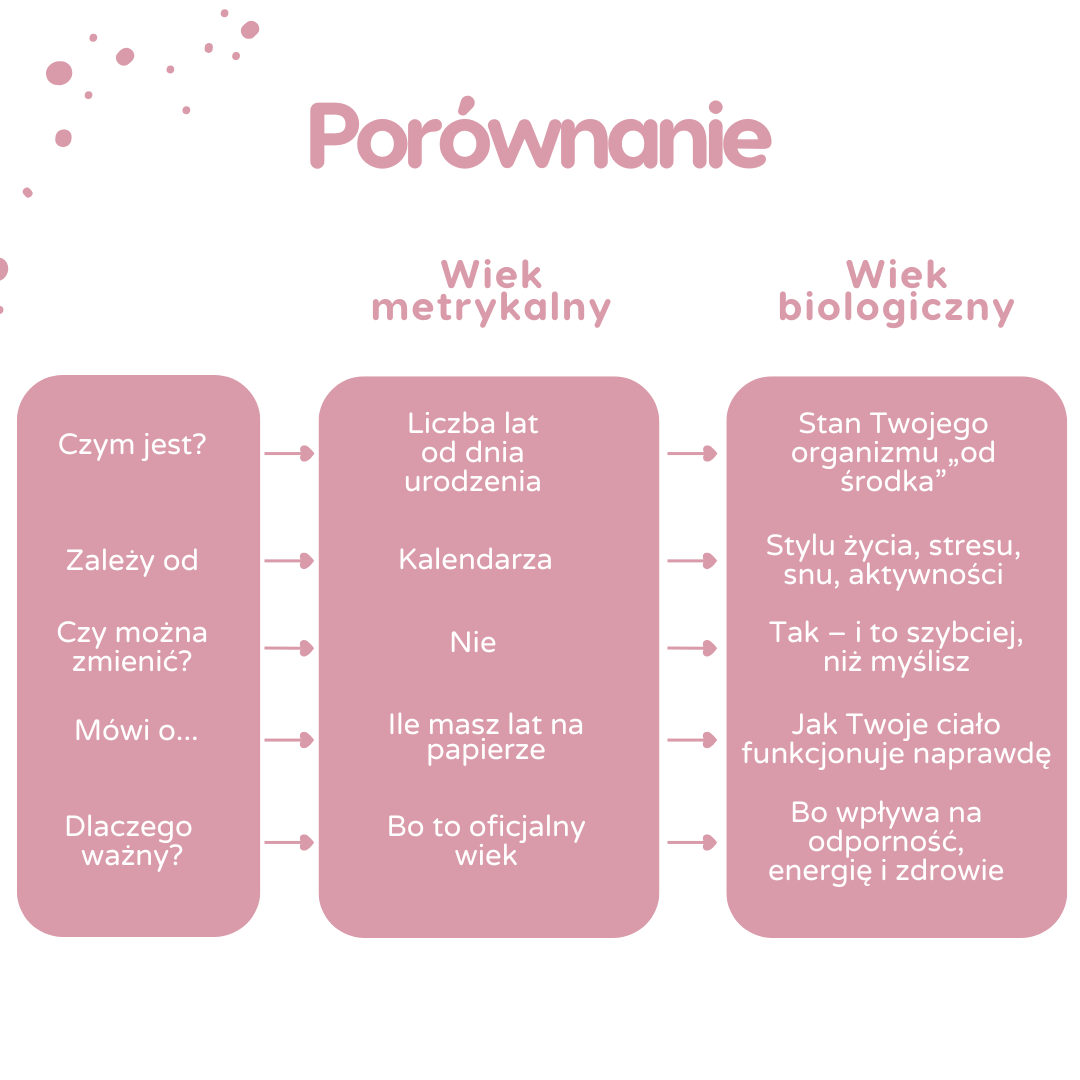
Simply put - the more you take care of yourself, the longer your body functions as if it were younger. And this is not just about skin cells, but also about the brain, immunity, heart, mood. Because youth is not just firm skin and a lack of wrinkles.It is lightness in the body, clarity in the head, resistance to fatigue.It is the feeling that your body supports you - and does not slow you down. That you are strong enough to go for a walk after a hard day. And tender enough to let yourself rest afterwards.
That is exactly why in this post we focus on three simple, everyday things - walking, sleep and friendship. They do not turn back time. But they make you feel again in time - your own.

Walking - movement that stops the clock
Sometimes it seems that to "change something" in your body, you need to start running, sweat at the gym or have a training plan written out by a personal trainer. Meanwhile, science says clearly: walking is enough.
A study conducted in the United States on more than five thousand adults showed that people who walked at least 150 minutes a week, had longer telomeres than people leading a sedentary lifestyle. What does this mean in practice? Their biological age was on average 6-8 years younger than their date of birth would indicate. And all this thanks to regular walks.
For comparison: 150 minutes a week is only 21 minutes a day. Or, if you prefer to count in steps - it is approx. 2100-2500 steps a day. As much as a walk to the store and back. Or one song from the "chill & walk" playlist, listened to in its entirety in the fresh air.

How to weave walking into everyday life?
A walk does not have to be a separate event in the calendar. It can just happen by the way:
- instead of scrolling after breakfast - a quick lap around the block in pajamas under a jacket
- instead of sitting with coffee - coffee in a thermos and a walk with a friend
- instead of commuting by bus right to the door - get off two stops earlier
- instead of the gym - a brisk walk with a dog or with a sister and topics to discuss (but the gym or home exercises provide additional benefits!)
- instead of an evening series - a short walk "for a breath" with a podcast or in silence.
These do not have to be big changes. One daily decision is enough for the body to feel the difference.
In the cited 2020 study, published in the Journal of Sports Sciences, researchers write:
"People walking ≥ 150 minutes per week had telomeres suggesting a biological age younger by 6.6-7.7 years compared to inactive people."
In other words - your body does not ask how old you are. It asks if it moved today.
And maybe that is why walking works. Because it is not another task. It is movement with tenderness - done for yourself, not against yourself. And your cells feel it. And they appreciate it very much.
Sleep - regeneration that acts like a retinol cream
When the day is too short and thoughts do not want to quiet down, sleep can be difficult. But sleep is not a luxury - it is an absolutely basic form of care. It affects not only mood and immunity, but also how long we feel young.
During sleep, the body starts processes that are hard to compare with anything else. It is at night that the skin regenerates most intensively – its blood supply increases, the protective barrier is rebuilt. At night, the body secretes growth hormone supporting cell renewal. During this time, the level of inflammation also drops – the one hidden in the background, which is responsible for accelerated aging. A good night's sleep literally smoothes - the body, mind and emotional reactions.
Studies show that sleep deprivation accelerates telomere shortening, and thus the aging processes of cells. Prolonged sleepless nights increase cortisol levels and reduce the body's ability to repair DNA damage. In other words - the less you sleep, the faster the body "wears out".
On the other hand, good quality sleep acts like a restart. After just a few nights of full-cycle sleep, you will notice a difference in the appearance of the skin, energy levels and how you react to everyday life. Interestingly, in one study, people who regularly slept for more than 7 hours had a higher level of the telomerase enzyme - responsible for maintaining telomere length.
If you are looking for a way to get better sleep, you do not have to look far. The body likes rituals - and operates according to its own biological clock, which we call the circadian rhythm. Its natural cycle is about 24 hours, and one of its main "guides" is light. This is what tells your body when to produce melatonin (the sleep hormone) and when to raise cortisol levels to wake up.
Therefore, it is worth:
- avoiding strong screen light at least 60 minutes before bedtime (phone, computer, TV)
- going outside in the morning, even for 10 minutes - daylight "resets" the circadian rhythm
- eating the last meal 2-3 hours before falling asleep, so digestion does not disrupt sleep
- sleeping in a cooler room (around 18-20°C), in the dark or with the blinds drawn.

In the evening, think about a tender winding-down ritual - as if you were telling your body: "you can let go now". It could be a warm shower, mindfully applying body cream, writing down three thoughts of gratitude. Or simply taking a few breaths by candlelight, without any plan. It is enough to start with one small "goodnight" said to yourself with tenderness.
Sleep is not only physical regeneration - it is also emotional rest. When you are mentally tired, the body also feels it: muscles are tense, breathing is shallow, thoughts loop. That is why it is worth taking care of space for yourself in the evening. Not to "have a productive morning", but because you deserve a peaceful night.
Sleep is a gift the body gives to itself, if only you let it.
Friendship and sisterhood - the youth hormone that comes without packaging
You can buy a peptide cream, you can invest in a facial massage, but one thing cannot be sealed in a package: a real, close relationship.
Scientists have been studying the impact of human connections on health for years, and the results of these studies are surprisingly concrete. It turns out that social support - meaning relationships based on closeness, trust and a sense of being seen - realistically slows down the aging processes.
One study published in the Proceedings of the National Academy of Sciences showed that people who declared a strong sense of emotional support had longer telomeres than people with a low level of social ties. Another study showed that women with a strong relationship network cope better with chronic stress - and as we already know, stress accelerates cellular aging.
From a biological point of view, a close relationship with another person lowers cortisol levels, regulates blood pressure, increases the production of oxytocin (the closeness hormone) and supports the immune system. From the heart's point of view - it provides comfort that is hard to replace with anything else.
Think for a moment about that one person you can talk to about everything - and about nothing. Maybe it's a high school friend with whom you share mutual silence and silly jokes. Maybe a sister you don't always agree with, but always support each other. Or maybe a colleague from work with whom exchanging a glance over coffee is enough to know you are not alone.
With whom do you feel truly yourself - without tension, without masks?
Have you had a chance to talk recently? Maybe today is the day to send a message, call, ask "hey, what's up?".
Sisterhood in everyday life is cooking together, holding hands, laughing at things only she will understand. It is also giving each other support when each of us needs it most. But also a simple conversation for no particular reason.
Because maybe the most important rejuvenating serum is not a product. Maybe it is a look that says: you are enough. Just as you are. And you are not alone in this.
Science confirms - but your body has always known
Research on telomeres, the circadian rhythm, oxidative stress and cortisol are fascinating proofs that our body truly knows how to regenerate. But maybe you don't need to know all these names to feel that something is working.
Maybe you don't need a scientific graph to know that you feel lighter after a walk.
That after a peaceful, full sleep you have clearer thoughts and more radiant skin.
That a conversation with someone close can take something off your shoulders that you can't even name.
What research confirms today, many women have always felt. That tenderness rejuvenates. Movement brings back life. Closeness rebuilds.
Your body does not expect perfection. It expects you to hear it. And science? It only comes with confirmation: what is good does not have to be difficult. And it does not have to cost anything.
Because sometimes the simplest things have the greatest power. Walk. Sleep. Friendship. You already have all this. You just need to make room for it.
Your serum is You
You don't need a new skincare routine to give yourself some light. Sometimes it is enough to remember that taking care of yourself does not start on a bathroom shelf - but much earlier. In a body that needs movement. In a head that needs quiet. In a heart that longs for closeness.
If today you are looking for a way to feel better in your skin - let it be something simple. Something that doesn't require special preparations or a plan.
Go for a walk today. Text a friend. Go to sleep earlier.
Your body will do more with this than you think.
Frequently asked questions
1. Do top notes always disappear after a few minutes? ▼
Not always at the same pace, but usually they are the most fleeting ones. Their task is to create the first impression, which is why they usually appear quickly and give way to the heart of the composition just as quickly. In some fragrances, this transition is very distinct, and in others, more fluid.
2. Does the base note always mean a heavy fragrance? ▼
No. The base does not have to be heavy or overwhelming. It is often simply responsible for what stays on the skin the longest and what organizes the entire composition. It can be woody, balsamic, musky, creamy or dry, but still subtle in perception.
3. Do single-note perfumes also have an olfactory pyramid? ▼
Yes, but in their case, it is not always about a clear change between successive stages. In Söppö's offer, this can be clearly seen in linear fragrances, where the same theme appears in the top, heart and base notes. Such a structure does not contradict the pyramid, but only shows its more cohesive version.
4. Where is it best to start if I am just learning to read fragrance notes? ▼
The easiest way is to start with clear fragrances focused on one direction or with compositions in which the differences between the opening, heart and base are distinct, but not overloaded. However, the most important thing is not to test too many perfumes at once and to give each fragrance a moment to develop on the skin.
5. Why can the scent from a blotter and the scent on the skin differ from each other? ▼
Because paper only shows part of the picture. On the skin, the composition reacts to body heat, hydration levels and the way it is worn. Therefore, the same fragrance may seem fresher, softer or more settled only after contact with the skin.
6. Does a more complex composition always mean "better" perfume? ▼
No. A more complex composition provides a different experience than a linear fragrance, but it does not have to be better by definition. Sometimes, a single note led consistently from beginning to end gives more pleasure. It all depends on what you are looking for and how you like to wear a fragrance.
7. Is it worth looking at the fragrance concentration when choosing a perfume? ▼
Yes, but with the right understanding. In technical communication, it is worth distinguishing perfume extract, meaning parfum / extrait de parfum, from eau de parfum or eau de toilette. However, the concentration itself does not tell everything about the perception of the fragrance, because the character of the notes and the structure of the entire composition also matter.