
Gourmand perfumes – can a scent taste like a memory?
Imagine opening the doors to a small pastry shop. First, you smell vanilla, right after that warm caramel and chocolate. Somewhere in the background, the aromas of roasted nuts and freshly ground coffee float in the air. Although you haven't tasted anything yet, you almost know what it all tastes like. It is exactly on similar associations that gourmand perfumes – fragrance compositions inspired by food, desserts, and other culinary pleasures. The word itself gourmand comes from the French language and means a foodie. It is hard to find a more fitting name.
One of the most important moments in the history of this fragrance family is considered to be the year 1992. That was when the iconic Angel by Thierry Mugler appeared on the market, which helped define modern gourmand perfumes. The sweetness of pralines, caramelized cotton candy, and vanilla was combined with the deep, earthy character of patchouli. There was something of a dessert in it, but also something completely new for the world of perfumes.
Since then, gourmands have shown many faces. They can be milky and creamy, intensely chocolatey, fruity, coffee-like, or spicy. Cinnamon brings a familiar warmth to such compositions, cardamom can surprise with a slightly citrusy freshness, and ginger and nutmeg add a spicy character. Sometimes saffron also appears, whose aroma can bring to mind leathery and slightly smoky accents.
Interestingly, notes associated with food do not have to appear on their own. Perfumers combine them with flowers, plant aromas, woody notes, and even salty accords. Because of this, gourmand perfumes can be rich, sensual, and pleasantly enveloping, but not necessarily overly sweet.
No wonder we reach for them so eagerly in the cooler months. They evoke associations with home warmth, favorite baked goods, and small pleasures. However, this does not mean they have to be put on the shelf with the arrival of spring. Lighter, fruity, or fresher interpretations of gourmand can equally well accompany us in the summer.
And what if, instead of another dessert, perfumes started to smell like something much more ordinary? Because is the scent of fresh bread sweet? And the slightly sour sourdough, the floury center, and the dark, crispy crust? Not necessarily. And yet, for many a foodie, they can be more tempting than the most elaborate pralines.
In the gourmand world, there is room for both fluffy cake and savory bakery accords. The right combination of ingredients allows the perfumer to recreate a familiar aroma that the human nose will recognize almost instantly.
And here lies a certain riddle. Why do we suddenly desire to wear something on our own skin that we usually want to eat?
Perhaps the answer does not lie in the taste at all…
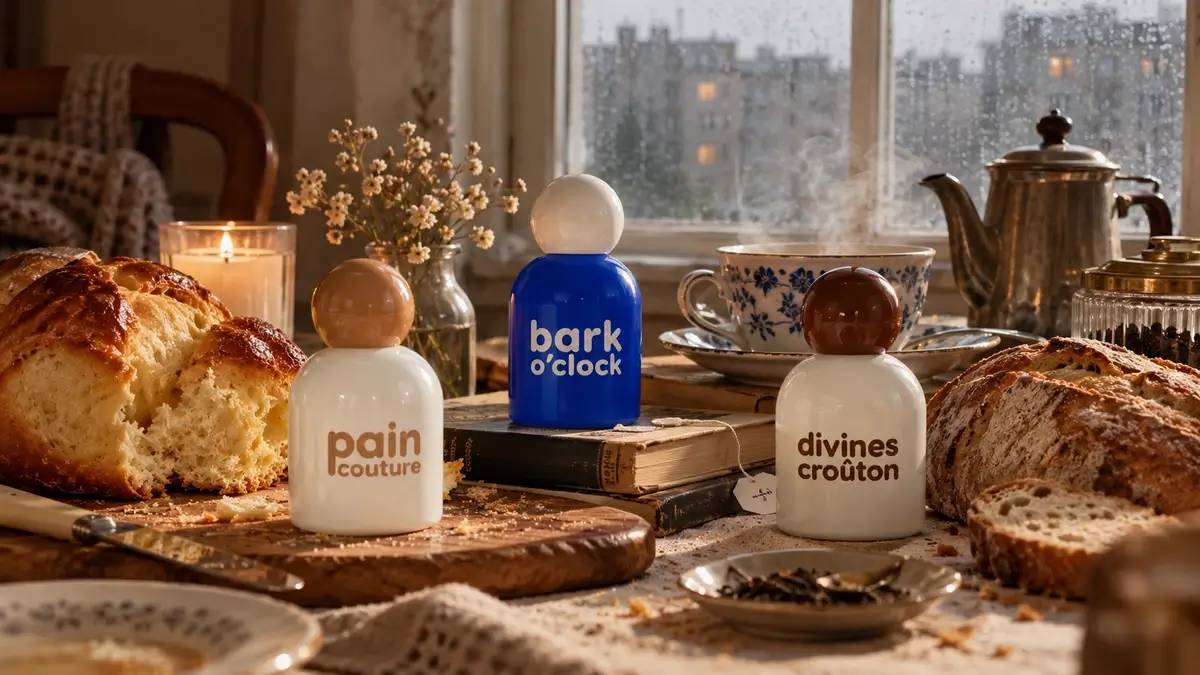
Pain Couture – a buttery brioche and the story of a pigeon who had everything
The delicate crackle of a golden crust. Underneath it, a fluffy, springy dough, still slightly warm, soft from butter. The aroma is so appetizing that for a moment you feel like breaking off a piece before anyone notices. Brioche doesn't need many additions. Its rich, buttery structure, eggy creaminess, and noticeable vanilla sweetness are enough.
It is exactly this French pleasure that is evoked by the brioche-scented perfume Pain Couture. It is a gourmand composition focused on one, very specific aroma – a fresh, buttery pastry. It doesn't pretend to be a bouquet of flowers or a complicated dessert. It smells like brioche. The kind that makes even an ordinary breakfast feel like a little celebration.
But at Söppö, no story is as innocent as it might seem.
The protagonist of Pain Couture is a white dove with an aristocratic pedigree. Monsieur has everything other birds could envy him for: family wealth, private service, and the right name. While his urban cousins search for crumbs on the sidewalks, he can afford to hold ordinary bread in contempt. After all, it is not fitting for every dove to eat just anything.
There is something disarmingly funny about this story, but also a hint of malice. Because does pleasure taste the same to someone who has to wait for it, and someone who has it at the tip of their wing?
Pain Couture smells of buttery luxury, but beneath the fluffy layer lies a question that is no longer so light.
Are we still capable of enjoying the things we have grown accustomed to?
Divines Croûton or sourdough bread, a gray housing estate, and the scent of home
And now imagine a completely different place.
There are no elegant storefronts or gilded signs here. It is an ordinary housing estate. Gray apartment blocks, a carpet beater, a cracked sidewalk, and a small bakery with a queue forming in front of it since morning. Someone walks out with a paper bag clutched to their chest. The bread is still hot. The crust crunches at the first press, and the aroma of the moist, soft interior escapes through a small crack.
This is exactly what the scent of Divines Croûton – a sourdough bread-scented perfume is like. Floury, yeasty, slightly tart, with a distinct note of a well-baked crust. There is no pastry sweetness in it. It is a simple, warm loaf that you can break in half before it has a chance to cool.
Behind this aroma lies the story of a city pigeon whose ancestors were once important messengers. They carried messages, covered huge distances, had their tasks and their place in the world. And then people stopped needing them…
What is left for someone who inherited a great history from their ancestors but didn't inherit a home? In the story of Divines Croûton, an ordinary piece of bread takes on a surprising meaning. It can be a small gesture of kindness. A reminder that someone noticed us. Something that doesn't cost much but can mean a whole lot.
Perhaps that is why the scent of sourdough bread feels so familiar. It reminds you of a slice eaten on a carpet beater, a kitchen where a breadbox always stood, or the walk home with a loaf from which the crunchiest pieces disappeared along the way.
Pain Couture and Divines Croûton tell the stories of two different worlds. One smells of privilege and a buttery brioche, the other of ordinariness and warm sourdough bread.
And yet, there is something you cannot inherit along with an estate or buy in the most elegant bakery.
The feeling that there truly is a place that is ours…
Bark O'Clock – the scent of Earl Grey tea and the secret of moments that have stayed with us
It is Saturday. It is already dark outside, although dinner has only recently ended. The TV is playing in the living room. Someone has just brought a teapot with tea, and next to it on the table stand glasses in metal holders. A teaspoon clinks softly against the glass. Just a moment, and everyone will sit down in front of one screen.
Do you remember evenings like these?
The tea is strong, almost tart. The characteristic aroma of black leaves floats in the air, broken by the distinct, citrusy freshness of bergamot. There is no need for milk or sugar. Earl Grey has its own character – elegant, slightly dry, hard to confuse with anything else.
We have captured this familiar aroma in the Earl Grey tea-scented perfume Bark O'Clock. Unlike the buttery brioche and sourdough bread, it is a tea composition. It does not try to resemble a sweet drink or a dessert. It recreates the intense scent of Earl Grey, with its naturally associated tartness and a bergamot accent.
But here too, something more lies behind the scent.
Bark O'Clock brings back the times when the whole family would gather in front of one television. Someone would block the screen at the least opportune moment, someone would forget to take the teaspoon out of the glass, someone would complain that the tea had already gone cold. Ordinary Saturdays. Sometimes even boring. So similar to one another that it would be hard to tell how one differed from another.
And yet, after years, it is exactly these that you can miss the most.
For the sounds coming from the next room. For someone's laughter. For the spot on the couch that was always occupied by the same person. Even for that annoying clinking of a teaspoon against the glass.
Maybe then we didn't know yet that we were participating in moments that would one day become so precious…
And maybe that is exactly where the secret of Bark O'Clock lies. The tea that we used to drink almost without a second thought turns out to be something more than just an ordinary infusion.
Because do we really miss its scent? Or maybe we miss someone who once sat on the other side of the table?
Why does the nose remember what the head has forgotten?
Sometimes a fraction of a second is enough. You pass someone on the street, you enter an unknown apartment, or you open a wardrobe that hasn't been used in a long time. Suddenly something changes. You don't know what yet. For a moment, you try to capture a familiar feeling, until finally you remember a place, a person, or an event you haven't thought of in years.
And all because of a scent.
In psychology, the phenomenon of recalling autobiographical memories through aromas is called the Proust effect, which we have already written about. The name refers to the literary scene in which the taste and smell of a madeleine dipped in tea open the door to the past for the protagonist.
This is not merely a beautiful metaphor. The sense of smell has particularly close connections with the areas of the brain involved in processing emotions and memory. Therefore, a scent can evoke not only the image of a specific place but also the atmosphere of the moment. Sometimes the feeling returns first, and only later do we remember where we know it from.
Interestingly, these associations are not universal. An aroma that means safety to one person may be completely indifferent to another. There is no single scent of childhood or one definition of home.
That is precisely why personal stories are so important at Söppö. Perfumes can become a sort of memory capsule, but it is the person who wears them that gives them meaning.
And perhaps what is even more interesting is that a scent doesn't only have to bring back the past. It can also accompany moments that will only one day become memories.
How to find a scent that will tell your own story?
In a perfumery, it is easy to get lost in the descriptions. A fragrance is supposed to be elegant, sensual, add confidence, or fit a specific time of day. But do we really always need perfumes that are meant to communicate something about us to others?
Sometimes it is enough that we simply like what we smell.
Therefore, when getting to know new compositions, it is worth forgetting about fashion and your own preconceptions for a moment. Instead of wondering if a given aroma is appropriate, try to notice what associations it brings up. Is it pleasantly familiar? Or does it intrigue you precisely because it would never have occurred to you to wear something like this before?
A good way to discover your own preferences are monoperfumes, which are compositions focused on one distinct note or fragrance accord. They allow you to better understand what you really like - sweetness, dryness, freshness, or more unobvious aromas.
If you have the opportunity, start with a sample. Test the fragrance on your skin and give it some time. The first impression doesn't always tell you everything about how you will perceive it after an hour.
You also don't have to look for perfumes for a grand outing. Perhaps a composition that you will want to wear on a completely ordinary Tuesday will give you the most pleasure.
Because, after all, not every good day has to be exceptional…
A story from the founder of Söppö – why do ordinary scents happen to be extraordinary?
In the perfume world, it is easy to be delighted by what is exotic, rare, and difficult to describe. However, another challenge is often much more interesting: to create a composition that smells like something perfectly familiar. So familiar that almost everyone recognizes it from the first contact with the skin, although it may mean something different to everyone.
At Söppö, we look at perfumes precisely through the prism of people, their emotions, and personal associations. As she captures the philosophy of the brand herself:
„We don't create perfumes to tell a story about ourselves. We create them so that someone can tell a story about themselves through them”.
In this approach, there is room for compositions that don't try to impress with the number of notes. Their strength lies in the readability of a specific aroma and in what it can trigger in the imagination of the person wearing it.
Because sometimes there is much more hidden behind one simple scent than behind the most elaborate pyramid.
And what does your home smell like?
Maybe it is the scent of something that has been gone for years. Or maybe the aroma of a completely ordinary day, the meaning of which you will only discover sometime later.
Not every story needs words to stay with us for a long time.
Some just need to be felt.
FAQ – frequently asked questions
Are gourmand perfumes suitable exclusively for autumn and winter?
Although gourmand perfumes are often associated with cooler months, they can be worn all year round. It all depends on the character of the composition and your preferences. Some love warm, buttery aromas on November evenings, others gladly reach for them also in the summer. After all, pleasure does not have to have its own season.
How are bread and other baked goods scented perfumes made?
Perfumers create so-called fragrance accords, which are combinations of ingredients that together recreate a specific aroma. Thanks to them, perfumes can resemble a crispy bread crust, buttery dough, or freshly baked brioche. This does not mean that real bread is in their composition. It is the art of recreating a sensation that our nose knows perfectly well.
Do monoperfumes consist of only one ingredient?
No. Monoperfumes focus on one dominant note, accord, or a specific fragrance sensation, but many ingredients can be used to create it. Their task is to render the chosen aroma as faithfully as possible. These are full-fledged perfumery compositions that allow you to get to know individual scents better and discover your own preferences.
Can gourmand perfumes be combined with tea scents?
Of course! However, it is worth remembering that not every combination has to appeal to your taste. The tart aroma of Earl Grey tea, such as in Bark O'Clock, can provide an interesting contrast to the buttery sweetness of a brioche. Such experimentation with scents is called layering. If you want to learn more, check out our guide on how to layer mono fragrances.
Are bread scented perfumes for women or men?
The scent of fresh bread has no gender. Just like the aroma of a brioche or a cup of strong tea. Perfumes inspired by everyday scents can be worn by anyone, regardless of the traditional divisions into women's and men's compositions. The most important thing is how you perceive them. Because, after all, your memories do not have to fit any label.