
Sometimes one fruit is enough. Ripe lychee broken in your hands. Passion fruit cut in half before you even find a spoon. A wild strawberry picked by the path and eaten immediately, still warm from the sun. Some aromas are so characteristic that they don't need a whole company of notes to stay in your memory.
This is exactly what the idea of monoperfumes is based on. Instead of building a multi-story story, they allow you to focus your attention on one scent and truly get to know it. Check how lychee smells when it doesn't lead to vanilla. How passion fruit fares without mango and a bouquet of flowers in the background. Whether you prefer juicy sweetness, slight acidity, or perhaps green tartness.
Fruit perfumes can, after all, have a very different character. And it is a single note that can show these differences exceptionally clearly.
Fruit monoperfumes – one scent in the foreground
In classic perfumes, fruits are often one of many elements of the composition. Bergamot, grapefruit, tangerine, or blackcurrant may appear at the beginning and later give way to flowers, spices, or woody notes.
In monoperfumes, it is different. One note, an accord, or a very specific impression remains the main theme of the entire fragrance. If we are talking about passion fruit scented perfume, it is passion fruit that is meant to play the lead role.
This does not mean, of course, that there is literally one ingredient in the bottle. Recreating a specific fruit may require combining many fragrance components. However, they all work in one direction: to create the clearest possible impression of lychee, passion fruit, wild strawberry, or rhubarb, instead of leading the nose through several completely different stories.
It is also a friendly way to get to know your own taste. It's easier to notice that you like sweet fruits, but not necessarily very creamy ones. Or that you are much more interested in the sour, green side of fruity notes than their dessert face.
At Söppö, monoperfumes have a 30% fragrance concentration. Such a high concentration allows the chosen note to resonate as fully and as long as possible, without adding heavy accords that could change its character. However, this does not mean identical longevity for every scent – individual notes have their own volatility and behave differently on the skin.
The most important thing remains the note itself. Sometimes, instead of a whole basket of juicy fruits, you really want to feel just one.
One fruit, different moments – how do monoperfumes develop on the skin?
Since the main theme remains the same, do monoperfumes change at all? Yes, but differently than a classic composition based on clearly changing top, heart, and base notes.
Immediately after application, the fruit may seem brighter, juicier, and fresher. Over time, the scent settles closer to the skin, and then it's easier to notice other shades of the same aroma: more sweetness, slight acidity, wateriness, or a green nuance.
The main character, however, does not disappear. Lychee remains lychee, and passion fruit remains passion fruit. It is rather the perspective from which you experience them that changes.
The skin itself and the ambient temperature also matter, so the first few seconds after application don't always tell everything. It's worth giving the fragrance a moment and checking which aspect of the fruit stays with you the longest.

Jelly Belly and Mad Gut – lychee and passion fruit in two different versions
The term "fruit perfumes" sounds like one category until you place two completely different fruits next to each other. Lychee and passion fruit show well how much can be hidden under the same name.
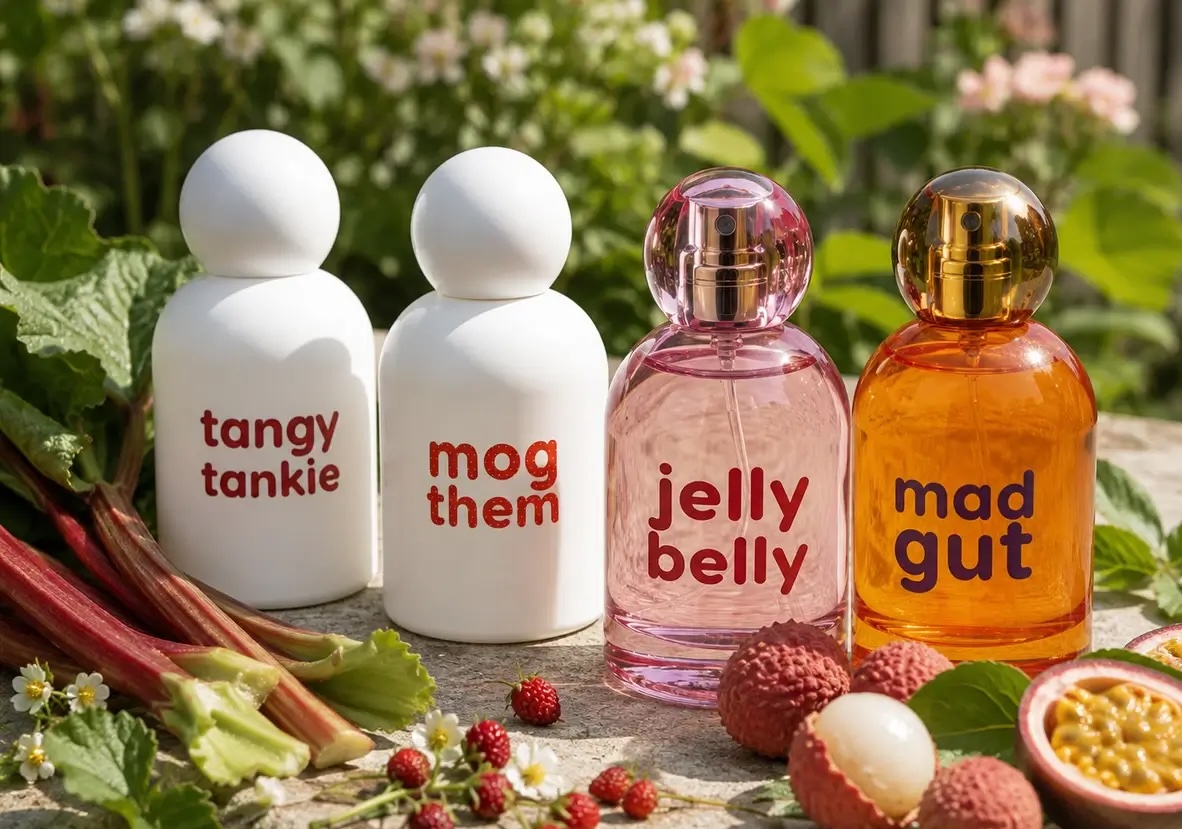
Jelly Belly – lychee without fragrance decorations
Lychee has a sweet, juicy, yet light and watery character. Under the rough, pink skin lies a bright pulp, whose aroma is hard to mistake for any other fruit.
In Jelly Belly it is precisely this side of lychee that remains at the center. The scent is fresh, fruity, sweet, and luminous. It is not meant to lead to a vanilla base or disappear under floral accords.
This is a good example of how sweetness doesn't have to mean a heavy scent. A fruit can be sweet while remaining light and juicy.
And this is precisely the pleasure of getting to know a single note: instead of wondering what it has been combined with, you can simply answer the question of whether you like the scent of lychee.
Mad Gut – passion fruit between sweetness and acidity
Passion fruit speaks a slightly different language. Alongside ripe sweetness, a characteristic acidity quickly appears, thanks to which the fruit remains juicy, tropical, and expressive.
In Mad Gut passion fruit doesn't need a whole exotic cocktail around it. It doesn't have to appear alongside mango, pineapple, or other tropical fruits for it to be clear which direction the scent is heading.
This is also a good example of how there is a lot of space between "sweet" and "fresh". You can like fruity notes precisely for their more acidic side. You can also look for exoticism, but without the scent of a whole basket of fruits at once.
Jelly Belly and Mad Gut belong to the same fruit family, and yet they tell completely different stories. One lychee and one passion fruit are enough to see how broad a concept fruit perfumes are.
Wild strawberry and rhubarb – other sides of the Söppö fruit collection
The fruity world of Söppö doesn't end with lychee and passion fruit. This is also well demonstrated by Mog Them as well as Tangy Tankie.
Mog Them focuses on wild strawberry – small, ripe, juicy, and sweet. It's not about the scent of a whole forest, earth, or a green bush, but about the fruit itself. It's a familiar fruitiness, closer to the Polish summer and the memory of wild strawberries found somewhere low by the path.
Tangy Tankie leads in a completely different direction. Rhubarb is fresh, herbal, tart, and slightly acidic. Instead of compote or cake, there is an impression of a broken stem and juice before anyone has time to add sugar.
Wild strawberry, rhubarb, lychee, and passion fruit show one thing well: fruity notes don't have to smell similar at all. Some can be sweet and soft, others tropical, watery, acidic, or green.
That's why the sentence "I like fruit perfumes" is often just the beginning of getting to know your own nose.
Fruit solo or part of a larger composition?
Söppö doesn't stop only at monoperfumes. The collection also includes more complex compositions in which fruits play a different role – they are not the entire scent, but one of the elements of a larger story.
This is clearly visible in the case of passion fruit. In Mad Gut it is the main theme. In Rogue it meets other fruity and fresh notes, including mango, pineapple, and papaya, green leaves, bitter orange flower, and mint. Thus, a broader, tropical picture is created, rather than a portrait of a single fruit.
Fruitiness works differently in Cherry Bomb. Black cherries and Marasca cherries appear alongside rhubarb, roasted almonds, tobacco, and deeper base notes. The fruit is still very distinct, but its character changes with the surroundings.
Neither of these paths is more "correct". Monoperfumes allow you to look at one aroma up close. A classic composition, on the other hand, shows what happens to it in the company of other notes.
Sometimes you just want passion fruit. Other times, it might be more interesting to see what passion fruit does when a whole world of scents appears beside it.
How to find your fruity direction?
Instead of starting with the question about the most beautiful fruit perfumes, it's easier to start with your own preferences.
If you are drawn to juicy sweetness, you might be closer to wild strawberry or lychee. If you like tropical fruits but are looking for more of an acidic character in them – passion fruit will be a more interesting direction. If sweetness is not what you are looking for, green and tart rhubarb shows a completely different side of fruity notes.
You can also treat monoperfumes like a small fragrance dictionary. You get to know one aroma, then another, and over time you begin to understand what you truly like, even in more complex compositions.
Terms such as women's fruit perfumes or men's perfumes can help organize the range, but they don't have to decide the choice. The scent of wild strawberry, passion fruit, or lychee has no gender. What's more important is which of them you simply want to spend the day with.
A few words from the founder of Söppö
In the world of perfumes, it is very easy to focus on the story of the creator. On their inspirations, vision, and what they wanted to encapsulate in the bottle. For me, however, it is equally important what happens later – when that scent reaches someone else.
That's why I like monoperfumes. They leave a lot of room for your own associations. One person will feel a vacation in the wild strawberry, another a childhood garden. Passion fruit can remind you of a journey or become the scent of a completely new moment that is yet to be recorded in memory.
We don't create perfumes just to tell stories about ourselves. A much more interesting question for me is: and what does this scent remind you of?
Because the same note can reach many people, but it never reaches exactly the same story.
FAQ – most frequently asked questions about fruit perfumes
Are women's fruit perfumes always sweet?
No. The term women's fruit perfumes covers very different directions – from the soft sweetness of wild strawberry or peach, through the juiciness of an apple, to more tart, green, or citrus aromas. Even within one fragrance family, completely different impressions can arise. Therefore, instead of assuming that fruit perfumes must be sweet, it's better to check what kind of fruitiness is closest to you.
Are fruit perfumes a good choice for summer?
Juicy fruits, citruses, and more luminous compositions are often chosen during summer days, as they harmonize well with associations of freshness, sun, and seasonal fruits. This does not mean, however, that you can only wear them in summer. If a scent brings you pleasure in autumn or winter, the season doesn't have to dictate any rules.
How does the scent of fruit perfumes change after application?
After the first spray, the scent becomes part of the skin's individual scent. Over time, its perception may become calmer, closer to the body, and some aspects of the fruit – sweetness, acidity, juiciness, or green character – may become more noticeable. Factors such as skin temperature and condition, as well as the conditions in which you wear the perfume, influence this. Therefore, it's worth getting to know the fragrance not just in the first few seconds after application.
Can fruity notes have an elegant character?
Most certainly. An elegant character is not assigned exclusively to heavy woody notes or classic floral bouquets. A fruit paired with the right accords can take on a more dry, deep, or structured character. In more complex compositions, fruity notes may meet cedar, sandalwood, musk, or flowers, and it is these combinations that can give perfumes greater elegance.
What flowers are fruity notes combined with?
Fruit-floral compositions can pair fruits with, among others, rose, peony, orange blossom, or jasmine. In classic perfumery, one also encounters Sambac jasmine, whose greener and fresher profile can co-create luminous, floral-fruity compositions. However, such pairings do not have to be the only way to wear fruits – in monoperfumes, all attention can remain on a single note.
Can fruit perfumes have an energetic character?
Some fruits, especially citruses, passion fruit, grapefruit, or more acidic apples, can be perceived as bright, vivid, and full of energetical character. However, this is a description of a fragrance impression, not a promise of a specific effect of the perfume on well-being. For one person, such an aroma will be associated with summer and movement; for another, simply with a favorite fruit.
Are fruit perfumes only for women?
No. Although terms such as "women's fruit perfumes" enjoy great popularity in search engines and help organize the range, fruits have no assigned gender. You can wear the same scent regardless of whether it would be described as female, male, or unisex on a store shelf. At Söppö, what matters more is the character of the aroma and how it sits on a specific person.
Can fruit perfumes be suitable for more elegant occasions?
Of course. Whether we perceive a perfume as everyday or more elegant, is determined by the entire composition and our own associations, not the mere presence of fruits. Darker cherries, blackcurrant, or fruits paired with wood, flowers, or a creamier base can create a completely different effect than fresh citruses. If such perfumes are a great choice for dinner, a meeting, or an important day, they need no further justification.
Can the scent of perfume add confidence?
Perfumes do not work according to one universal pattern. However, we can have scents that we associate with specific moments, style, or the way we want to express ourselves on a given day. For some people, a favorite perfume becomes part of an outfit or a personal ritual and can be linked with the association of self-confidence. This is a very individual experience – which is why it's worth listening more to your own senses than to perfumery rules.